
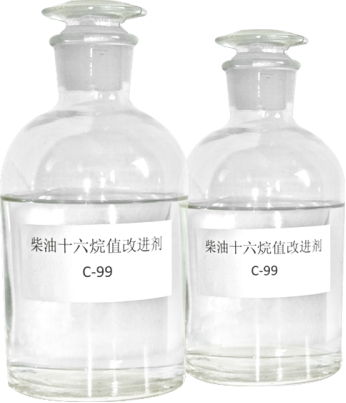
The cetane number(CN) of diesel is an important quality indicator of its combustion and antiknock performance, and its value has significant effects on engine cold start, pollutant emissions, fuel consumption and operating noise. Generally speaking, the higher the CN of diesel, the shorter its ignition delay period, the lower the degree of difficulty of autoignition, and the better the combustion performance of the diesel. If the ignition delay of diesel is long, the injected fuel will burn suddenly when the temperature and pressure reach sufficiently high levels, producing “knowck” (knock). In recent years, the trend toward heavier crude oil in countries around the world has become increasingly serious, and refineries generally adopt the catalytic cracking secondary processing process to increase the output of light oil, but diesel produced by this process has a low CN and poor stability, making diesel blending and delivery difficult. China stipulates that the CN of diesel shall not be lower than 45. The new light diesel standard also requires an increase in the cetane number. Therefore, improving the cetane number of diesel is one of the urgent problems to be solved. To improve diesel quality and meet environmental protection requirements, adding an appropriate amount of cetane number improver (CNI) to diesel is an effective way to increase the CN of diesel and improve diesel combustion efficiency. Adding CNI to diesel can significantly increase diesel CN; reduce exhaust emissions: in the same engine, using diesel with a low CN produces more particulate emissions than using diesel with a high CN; improve combustion performance; improve lubricity: reduce the wear rate of the fuel injection pump, engine block and connecting rods, and extend service life; have good safety performance: the advantages in transportation, storage and use are obvious; and have good economy: because of the low dosage, the cost is lower than blending diesel to the same CN. Research on CNI began in the early 1930s, and by now multiple types of substances have been developed. However, the main products most widely used commercially are the nitrate ester series. Among them, 2-ethylhexyl nitrate (isooctyl nitrate) is the most widely used due to its high cost-effectiveness. It has the following many characteristics: stable in storage, good stability; good response to oil; does not affect other properties of diesel and does not interfere with other additives; improves diesel engine starting performance, cleans nozzles, reduces exhaust emissions, saves energy and reduces consumption; reduces engine noise, especially at low temperatures and low speeds; extends engine life and reduces maintenance costs. To meet market demand, the company independently developed the diesel cetane number improver C-99 (isooctyl nitrate). The product features high purity and low impurities, has established an enterprise standard (Q/JXG 003—2017) and achieved scale production. The product has been promoted and applied in the Sinopec system, and its main quality and technical indicators have reached the performance level of similar international products, winning the praise of users.
Working Principle
During the ignition delay period of diesel, isooctyl nitrate is easily decomposed at the O–N bond and other positions due to the high temperature and high pressure in the cylinder, generating gas-phase catalysts and a large number of free radicals, etc. Because of its low decomposition activation energy, the activation energy in the fuel autoignition process is reduced to the decomposition activation energy of the cetane number improver. It reacts with the diesel-air mixture to promote fuel combustion; after isooctyl nitrate is added to diesel, due to the participation of free radicals, the fuel can undergo oxidation reactions even at lower temperatures, improving the ignition performance of the fuel. At the same time, the decomposition products of CNI become initiators of chain reactions, accelerating the reaction rate, shortening the ignition delay period, and increasing the CN of the fuel.
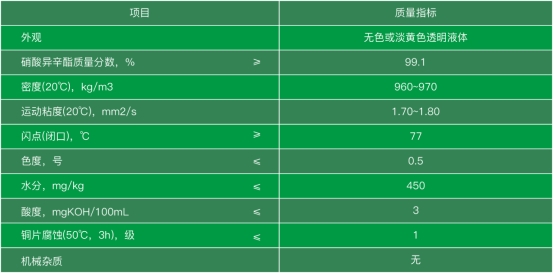
Physicochemical Properties
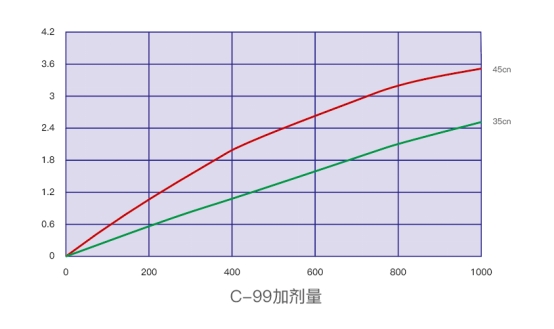
C-99Typical response curve in diesel