I. Basic Introduction
The lubrication of automotive low-sulfur diesel is critical to the performance and service life of diesel engines. If the diesel has poor lubricity, it cannot provide reliable lubrication for the fuel pump and injectors, leading to problems such as wear of precision engine components, reduced fitting accuracy, poor diesel atomization, insufficient engine power or unstable deceleration; in severe cases, it can cause fuel pump leakage and shorten the service life of diesel engines.
The main components of diesel are mixtures of hydrocarbons and non-hydrocarbons. Hydrocarbons mainly include alkanes, cycloalkanes and aromatic hydrocarbons; non-hydrocarbon compounds mainly include sulfur-containing, nitrogen-containing and oxygen-containing compounds. Research has found that aromatic heterocyclic compounds with strong polarity, nitrogen-containing polar compounds and acidic components are the effective lubricating components in diesel.
As environmental regulations become increasingly stringent, control over indicators such as the sulfur content in diesel is getting tighter. Refineries must adopt refining methods such as deep hydrodesulfurization to reduce the sulfur content, and at the same time, some natural lubricating substances in diesel are also removed. Studies have shown that when the sulfur content in diesel drops below 500 ppm, the lubricity of the diesel decreases significantly.
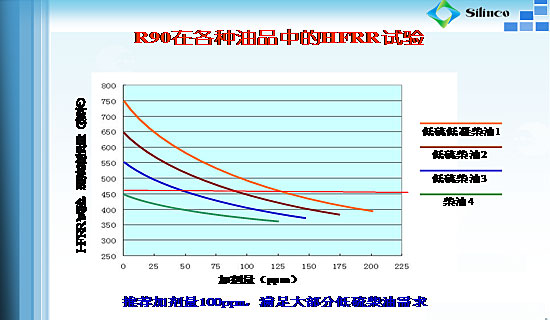
China has begun to implement the National III diesel standard (GB/T 19147-2003), and the National IV diesel standard (GB/T 19147-2009) will soon be enforced in 2015, when the sulfur content under the National IV diesel standard will be reduced from 2000 PPM to 350 PPM (50 PPM in Beijing and Shanghai). The lubricity of automotive low-sulfur diesel will become a serious problem affecting the normal operation of diesel engines. To ensure diesel lubricity, industry standards such as those of Sinopec stipulate the lubricity indicator requirements for automotive low-sulfur diesel (HFRR<460µm).
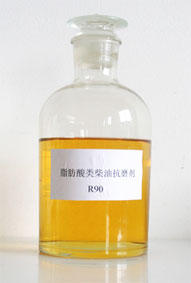
Using a diesel anti-wear additive is an economical and effective means of improving diesel lubricity; adding about 200 ppm can bring the diesel lubricity up to the requirement. To meet market demand, the company independently developed the fatty-acid-based diesel anti-wear additive R90. The product features a low pour point, high flash point, stable acid value and excellent lubricating performance. The company has established an enterprise standard and achieved scale production. The product's main quality and anti-wear indicators have reached the performance level of similar international products and have won unanimous praise from users.
II. Working Principle
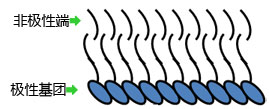
The main components of the anti-wear additive R90 are all polar molecules, which have good mutual solubility with diesel. The polar molecules are dispersed in the diesel; when in use, the groups of these polar molecules adsorb onto metal surfaces to form an oil film, creating a protective layer on the metal surfaces and effectively reducing mechanical wear. Because the fatty acids, the main components of the R90 anti-wear additive, are obtained through repeated purification from raw materials, the impurity content is extremely low, and the relatively high freezing point allows use under any environmental conditions while ensuring that, when added to diesel, it does not flocculate, decompose or settle.
III. Physicochemical Indicators
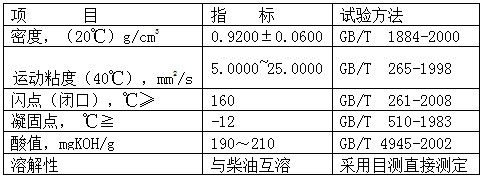
IV. Response Curve in Diesel